
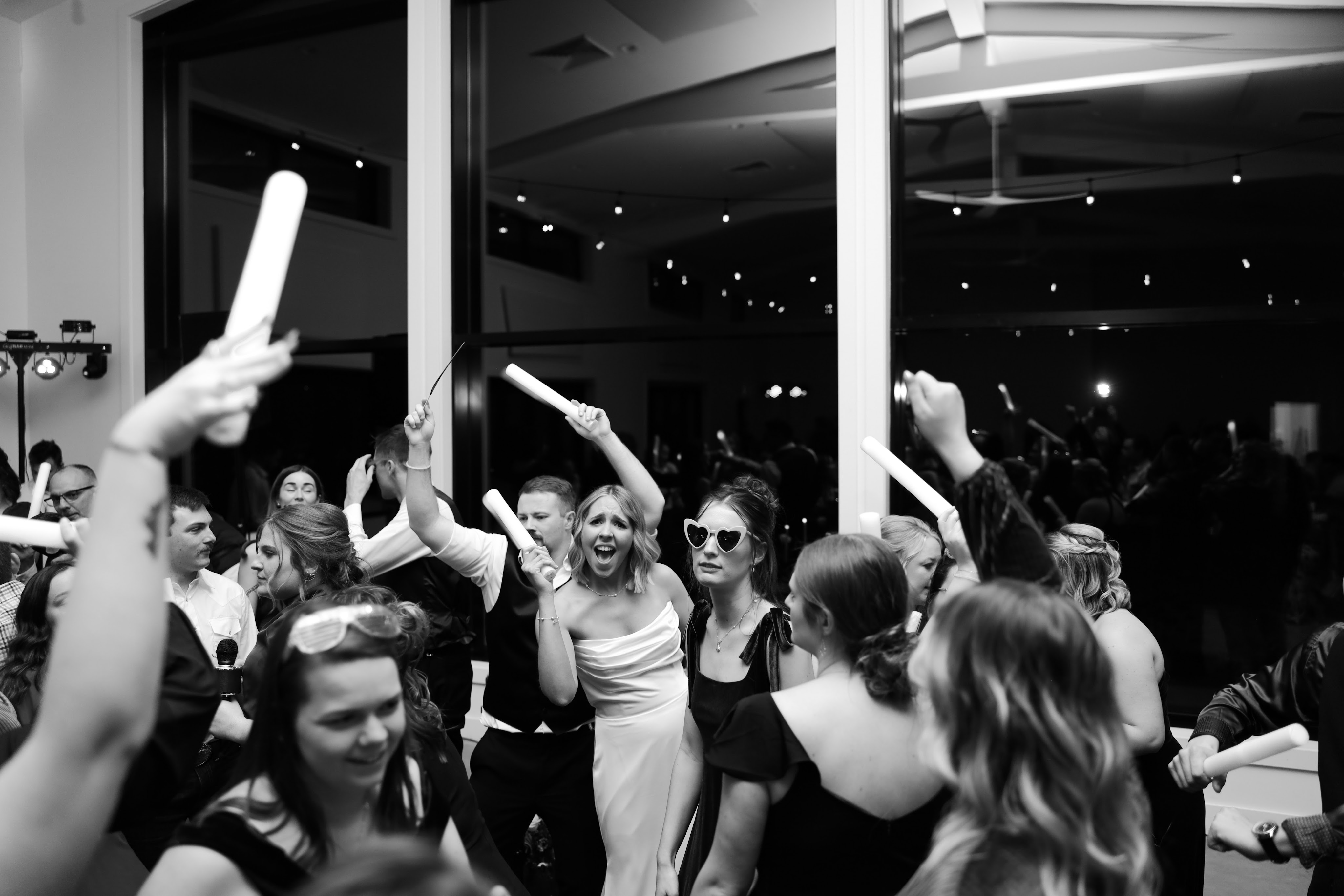
A couple sat across from me last month and asked, “what do you do to keep the dance floor packed?”
It’s the question I get most often on initial calls. Every couple has been to a wedding where the floor stayed empty all night, and they’re terrified theirs will be the same. They expect me to start talking about song choices, BPM transitions, reading the crowd. All of that matters. But it’s not what actually decides the night.
After nine years of weddings in Central Ohio, I’m pretty sure there are two rules that determine whether a dance floor stays packed, and most couples never hear either one. Neither has anything to do with what the DJ plays.
Rule 1: The Couple Has to Be On the Floor
If you’re sitting at your sweetheart table, your friends will sit too.
It sounds obvious when you say it out loud. But you’d be surprised how often a couple plans a beautiful reception, the music is right, the energy is building, and then the bride and groom plant themselves at their table because they’re tired, hungry, or want to chat with parents. And the dance floor empties out within twenty minutes.
The dance floor follows the couple. Not in some mystical way. Literally. Your friends are watching where you are. Your wedding party is watching where you are. If you’re sitting, they read that as “okay, dancing’s over, let’s catch up at the table.” If you’re on the floor, they stay. The room reorganizes around wherever you put yourself.
What I tell couples who want a packed floor is to plan their reception with this in mind. Eat fast, hit the floor early, and stay there until the night ends. If you want to sit and rest, that’s totally fine, but understand the floor will dip when you do. Use those dips for cake cuts, toasts, last calls at the bar. Don’t let them happen during peak dancing time.
The other piece is the sweetheart table itself. Some couples are doing away with it entirely now and just sitting at a head table with their wedding party, or even at a regular guest table. It’s harder to disappear when you’re surrounded by your people. The dance floor pulls them along too.
Rule 2: Put the Bar in the Same Room as the Dance Floor
This is the one that breaks weddings, and almost nobody catches it until it’s too late.
If your bar is in a separate room or hallway from the dance floor, the floor will empty out every twenty to thirty minutes for a full re-up cycle. Guests grab a drink, get pulled into a side conversation, sit down at a table out of view, and now they’re not coming back without an active push.
If the bar is in the same room as the floor, that cycle never breaks. People grab a drink, look up, see the floor going, and walk straight back into it. Twenty feet of carpet makes the difference between an electric night and a polite one.
I’ve seen this kill weddings at venues you’d never expect. Beautiful spaces with the bar tucked into an adjacent foyer because that’s where the line forms cleanly. Logistically smart. Energetically catastrophic. By 10pm half the room is hanging out by the bar, and the floor has nine people on it.
When I walk a venue with a couple, this is the first thing I’m looking at. Where’s the bar? Is it visible from the floor? If not, can we move it? Most venues will work with you if you ask early. Some won’t, and then you need to decide whether to push back service to specific windows, set up a satellite bar in the main room for the dance set, or just accept the dip and plan toasts around it.
Strongwater and Franklin Park Conservatory both have configurations where the bar can sit in line with the floor if you ask. Some of the newer Granville and German Village venues have built-in bars that aren’t movable. Worth checking before you sign a venue, not after.
A Bonus Rule on Timing
If I’m going to give you a third one, it’s about the length of the open dance set.
I’ve asked enough couples about their timelines that I’ve got the data now. Open dance sets under two hours never quite peak. The floor takes thirty to forty minutes to fill, and you only get the back half of the energy curve before it’s time to wrap. Over two and a half hours, you start losing energy in the back third. People are tired, kids need to go home, parents have been on their feet too long.
Two to two and a half hours is the window you want to land in. Anything outside it needs a real reason.
What This Means When You’re Picking a DJ
People expect to hire a DJ on song choice. That’s a real piece of it. But what you actually need is someone who’s going to walk your venue with you, see the bar placement, ask about your sweetheart table layout, and tell you straight if anything in the room is going to fight you on the dance floor.
A working DJ has seen enough rooms to know which configurations win and which ones lose. That’s the kind of conversation you want in your initial calls. Not just “what do you play.” Where are you putting people. How does the night flow. What’s the floor going to look like at 10pm.
If you want to talk through your specific venue layout and what would actually pack your floor, reach out through the contact form and we’ll figure it out together.