
We walked into a barn venue in Granville last summer at 4pm and the room looked tired. Beige walls, hay-bale ceilings, exposed wood that read as rustic at noon but felt washed-out and flat under the overhead fluorescents. The couple was already nervous about how their photos were going to turn out.
At 7pm, after we’d run 28 wireless uplights around the walls in deep amber and the venue had cut their houselights to half, the same room looked like a different building. Photographers were shooting tight on the head table because the wall behind it had become a moody, glowing backdrop. Guests were complimenting the bride on her “lighting designer.” There wasn’t one. It was eight pounds of LED uplights and a remote control.
That’s the honest version of what lighting does at a wedding. It’s not a luxury upgrade. For 75% of Columbus venues, it’s the difference between a room that photographs flat and a room that photographs like a real moment.
Here’s what each type of lighting actually does at a reception, what it costs, and where it earns its money.
Uplighting: the one upgrade that’s basically always worth it
Uplighting is wireless LED fixtures placed along the perimeter walls of your reception space, set to a color you pick. They run on internal batteries (so no cables on the floor) and most modern ones can shift color on cue, so we can run warm amber for dinner and then snap them to deep magenta or plum the moment the dance floor opens.
The reason it works is that almost every reception venue has at least one wall that needs help. Strongwater has those gorgeous brick walls but they go visually flat without color hitting them. The Vue has the skyline view but the inside walls are basic drywall once the sun drops. Beverly Mansion is beautiful but cavernous, and uplighting tightens the room in around the guests.
Real pricing in Columbus: most DJs charge $200 to $600 for an uplighting add-on depending on how many fixtures and whether color changes are included. In our own experiences, 8 wireless uplights are built into The Real Mix Experience at $2,499, and the full 32-fixture room transformation is built into The Real Show Experience at $2,999. The jump from 8 to 32 fixtures is the difference between “the corners look nice” and “the whole room glows.”
Dance floor lighting: necessary, not optional
This is the moving-light category. Beams that sweep across the dance floor in time with the music, color washes, strobing effects on the chorus drops.
The mistake couples make here is treating it like a “nightclub” upgrade. It isn’t. Dance floor lighting is what tells your guests that the room has shifted from dinner-mode to party-mode. If the lights stay the same during dinner and dancing, the dance floor stays half-empty, because guests don’t feel a clear shift signal. With dance lighting, the moment the floor opens, the room literally changes. People move toward the energy.
We run dance floor effects in every tier because they’re not negotiable for us. The question is whether you want the basic moving heads or the upgraded setup that includes pixel-mapped effects timed to the actual song.
One thing we’d push every Columbus couple to ask their DJ: are the dance lights on automation, or are they being run live? Most lower-tier DJs put their lights on auto-mode and let them just blink to a generic preset. The lights still move, but they’re not actually timed to anything. A real DJ runs the lights live, syncing the color shifts to the song structure. You can feel the difference in the room, and the photos look different too.
Monogram projection: more useful than you’d think
A monogram is a custom-cut light pattern projected onto a wall or the dance floor. It’s usually your initials, your wedding date, or a custom design. The fixture is called a gobo projector, and it’s a one-time setup cost.
Two reasons it earns its place. First, photographers love it. A clean monogram on the wall behind the head table or projected on the dance floor gives them another texture to shoot. Second, it personalizes a venue that’s hosted 200 other weddings. Strongwater hosts somebody’s wedding every weekend. The monogram makes it feel like yours.
We price this as an add-on at $299. It’s the cheapest upgrade in the whole lighting suite, and it shows up in more photos than almost anything else.
RF-controlled foam glow sticks: the one almost no one in Columbus does
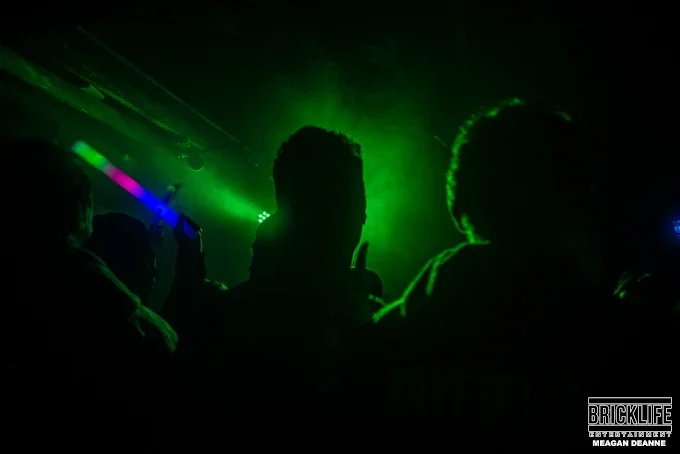
This is our favorite. A few hundred wireless-controlled LED foam sticks distributed to guests at the start of open dancing, all synced to our lighting board. Think Taylor Swift Eras Tour bracelets, but at your wedding.
When the dance floor opens, every guest gets one. As the lighting on the dance floor changes color, the foam sticks change color in sync. When the song hits a drop, we can pulse all 50 sticks in unison. It’s the single most-photographed moment of any reception where we’ve run them.
No other Columbus wedding DJ we know is doing this yet. We won’t lead with it because we don’t want to come across as gimmicky, but if you’ve ever been to a concert and watched a stadium light up in waves, that’s the energy on a 150-person dance floor. It’s surreal in the best way.
Ambient and dinner lighting
This category gets forgotten. During dinner and toasts, the room shouldn’t be at full party brightness, but it also shouldn’t be venue-overhead-lights-only. The right call is to dim the venue’s overheads, keep warm uplighting on the walls, and let candles and centerpieces do the heavy lifting on guest tables.
Most Columbus reception venues will dim their overheads for you on request. Conservatory and conservatory-style spaces are the exception because they’re often relying on natural light by design. For those rooms, our move is heavier uplighting and string lights, not dimming.
Where lighting earns or loses its money by venue
Quick Columbus venue cheat sheet, since this is what couples actually want to know.
- Strongwater. Uplighting on the brick is unreal. Skip dance floor lighting at your peril; the room is too big to feel intimate without it.
- The Vue. Floor-to-ceiling windows mean ambient daylight dominates until sunset. Lighting earns its money after 7pm. Plan a dance floor that benefits from full lighting transformation.
- Beverly Mansion and similar mansion-style venues. The room is gorgeous on its own. Uplighting in a soft accent color (deep plum, blush, amber) flatters the architecture without competing with it.
- Granville and Delaware County barn venues. Lighting is the single biggest visual upgrade you can make. Heavy uplighting + dance floor lighting + monogram is the combination that consistently transforms these rooms.
- Franklin Park Conservatory and glass-wall venues. Uplighting is partly wasted because the glass eats it. Pivot the budget toward string lights, dance floor effects, and monograms.
- Downtown loft venues like Budd Dairy. Industrial spaces benefit massively from color saturation. Don’t go subtle.
The practical advice
If your budget is tight and you can only pick one lighting upgrade, pick uplighting. Get the full-room option (24+ fixtures) over the corner-accent option (8 fixtures). It changes the photos more than any other single decision.
If you have room for two upgrades, add the monogram. It’s cheap, it shows up in photos, and it personalizes a venue that hosts dozens of other weddings a year.
If you have room for three, ask about the foam stick option. It’s the moment your guests will text each other about the next morning.
Want to see what lighting can do for your venue?
We do a lighting walk-through during planning meetings. We pull up your venue, talk through what’s worked at similar rooms, and figure out the right tier for your night and your budget.
Logan